A Glasgow drone start-up has successfully flown a long-range drone on a round trip of around 14km out over the open sea, entirely beyond its operator’s line of sight, in one of only six projects chosen nationally by the UK Civil Aviation Authority in 2024 to support bringing routine long-distance flights into UK airspace.
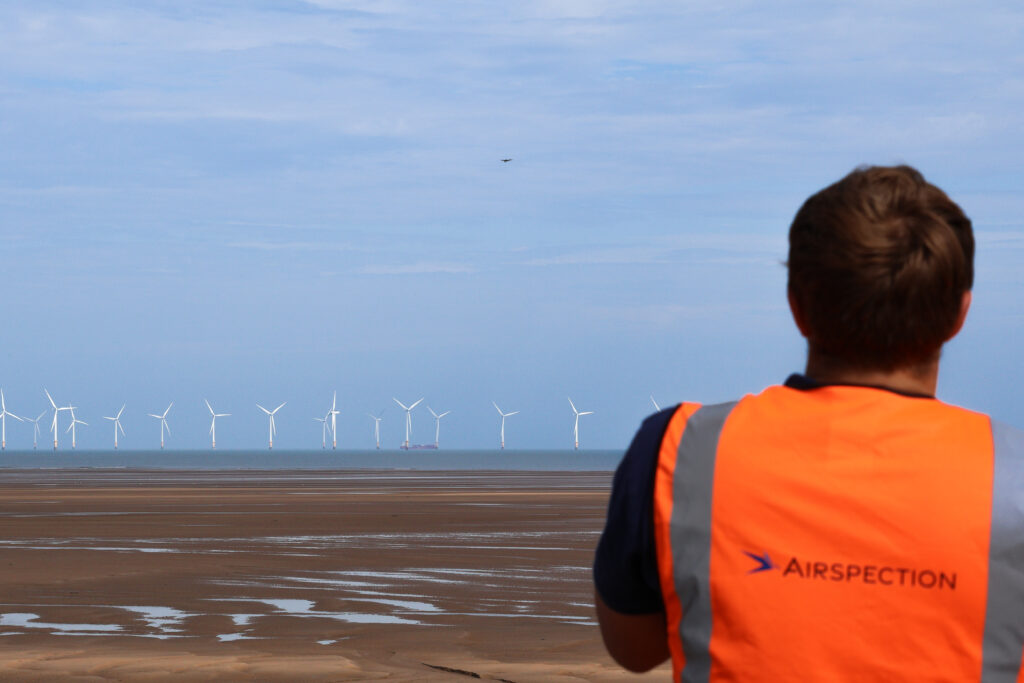
Airspection carried out the flights off the coast of Liverpool Bay, launching from the shore and operating the aircraft out towards a working offshore wind farm and back. The approach points to a safer, lower-carbon alternative to the crewed vessels currently used to reach offshore infrastructure.
The CAA selected Airspection in August 2024, alongside the National Police Air Service, NATS, Project SATE and Project Lifeline. Run as an innovation sandbox with UK Research and Innovation, its aim was to gather the safety evidence needed to integrate Beyond Visual Line of Sight (BVLOS) drones into UK airspace and make long-distance flights routine.
For years, flying a drone beyond the pilot’s line of sight has meant securing one-off permissions and closing off the airspace. The CAA’s sandbox exists to change that, building the safety evidence needed to make routine, integrated BVLOS operations standard. Proving a shore-launched aircraft can fly out to a working wind farm, inspect it up close and return safely, alongside other airspace users, is a real step towards that, and towards turning offshore wind inspection into a repeatable service.
Offshore wind is one of the most demanding environments in which a drone can operate, combining long distances, harsh weather, complex regulation and difficult access. Today, inspecting offshore infrastructure still means sending people and vessels out to sea at significant cost, carbon and risk. A support vessel can burn several hundred litres of diesel an hour. Airspection’s approach removes much of that by launching from the coast instead.
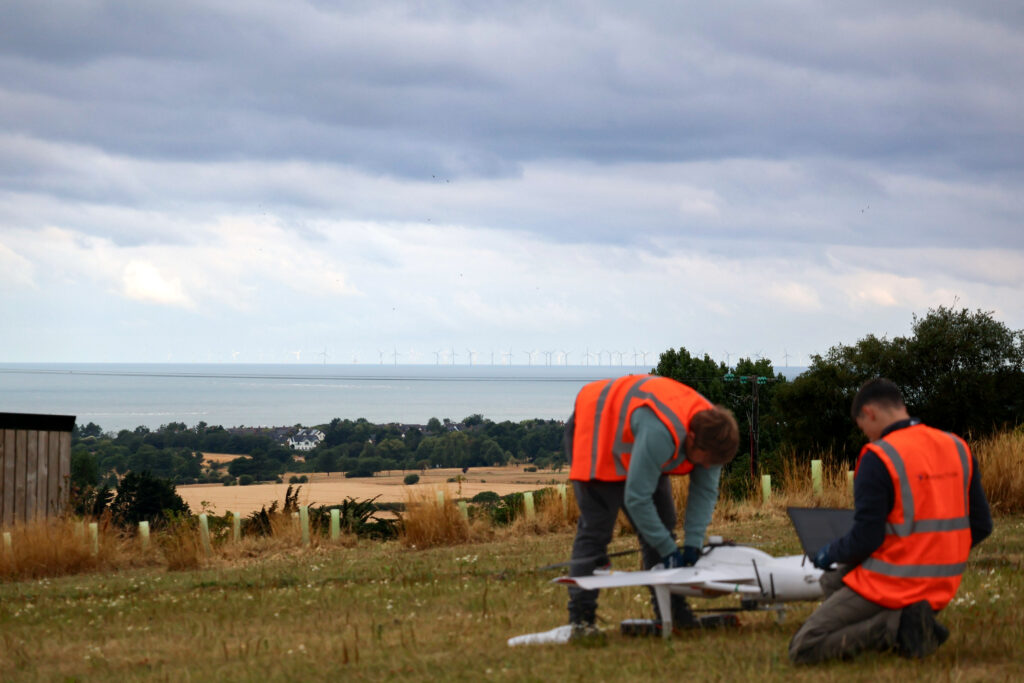
Over two years working with the CAA’s Innovation and Test and Evaluation teams, the company built not just an aircraft but the full safety, communications and flight operations system that BVLOS flight demands. The Liverpool Bay campaign proved it could launch from shore, fly out over the sea towards a live wind farm and return safely, using an operating system designed for repeatable commercial missions.
The aircraft is also built to do something most drones cannot: hover efficiently in strong wind. Inspired by the way a kestrel holds its position in a gale, it works with the wind rather than fighting it. In testing at wind speeds of 10 to 12 metres per second, the technology cut hover power consumption by around 40 per cent, giving roughly two-thirds more flying time. Within limits, stronger winds can make the aircraft more efficient rather than less.
Airspection estimates the approach can deliver up to 50 per cent cost savings against standalone inspection campaigns, save around a tonne of CO2 equivalent per turbine and improve site access by up to 25 per cent. The commercial case has been independently assessed by the Offshore Renewable Energy (ORE) Catapult, whose analysis of reference UK wind farms found that drone inspection launched without a dedicated vessel could cut inspection costs substantially against conventional rope-access methods.
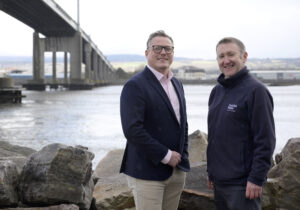
Matthew McLean, Co-Founder and Managing Director of Airspection, said: “This was about proving you can operate a drone offshore, beyond line of sight, launched from the shore rather than a boat. If you can do that reliably, you take people out of a dangerous environment and cut the cost and emissions of getting them there. We proved it around offshore wind, but it applies to any remote infrastructure.”
Ed Clay, Head of Technical Strategy at the CAA, said: “Expanding BVLOS capabilities is a critical step towards scaling innovation, accelerating industry growth, and transforming how UAS contribute to public and commercial services. Offshore operations are a capability that can deliver real growth and positive outcomes from both a commercial, and safety perspective. The data and learnings provided by Airspection will help in the development of the UAS-supporting policies the CAA is developing through its Future of Flight Programme.”
The Liverpool Bay programme was supported by the Offshore Wind Growth Partnership (OWGP), whose funding enabled Airspection to develop and demonstrate its shore-launched BVLOS capability offshore. The work addresses one of the sector’s priority areas for next-generation operations and maintenance: safer, more efficient methods of remote inspection and monitoring for offshore wind.
Tom Speedie, Project Manager at Offshore Wind Growth Partnership, said: “Supporting innovative Scottish companies like Airspection is exactly what the Offshore Wind Growth Partnership exists to do. Our funding helped the team develop and demonstrate a shore-launched drone capable of operating offshore beyond visual line of sight, addressing one of the sector’s key priorities: safer, more efficient methods of remote inspection and monitoring. It’s a strong example of the kind of next-generation operations and maintenance technology that will help the UK’s offshore wind industry grow.”
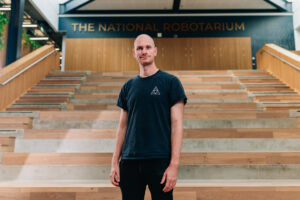
Airspection was co-founded in 2022 by Matthew McLean, who studied Aero-Mechanical Engineering at the University of Strathclyde. The company grew out of his work there and was supported in its earliest days by Strathclyde Inspire, which helped fund its first prototype.
Beyond offshore wind, Airspection is now exploring where the same combination of long range, endurance, efficient hovering and high-wind capability delivers most value, including rapid route proving for railways after storms, assessment of power networks and other remote infrastructure.