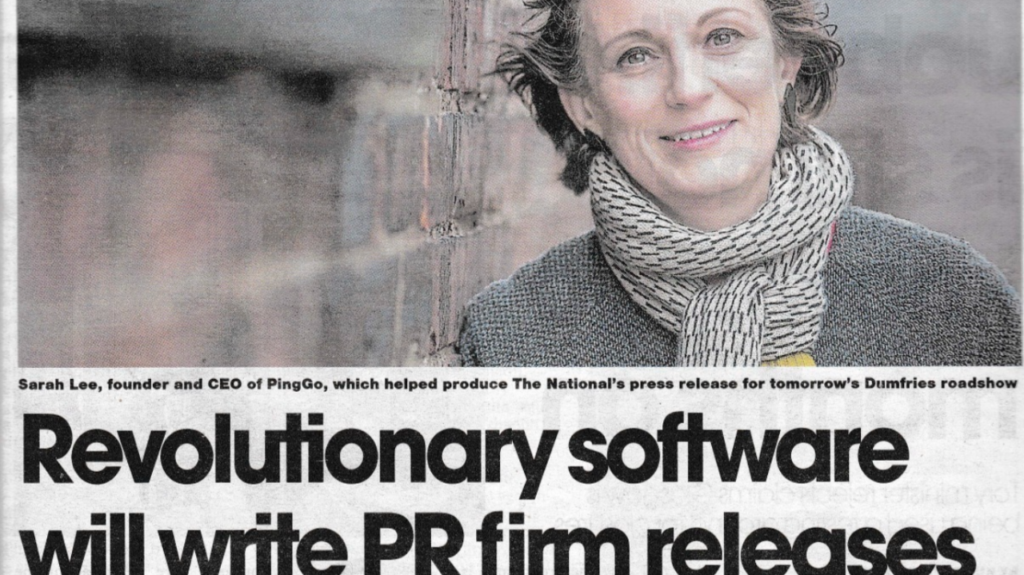
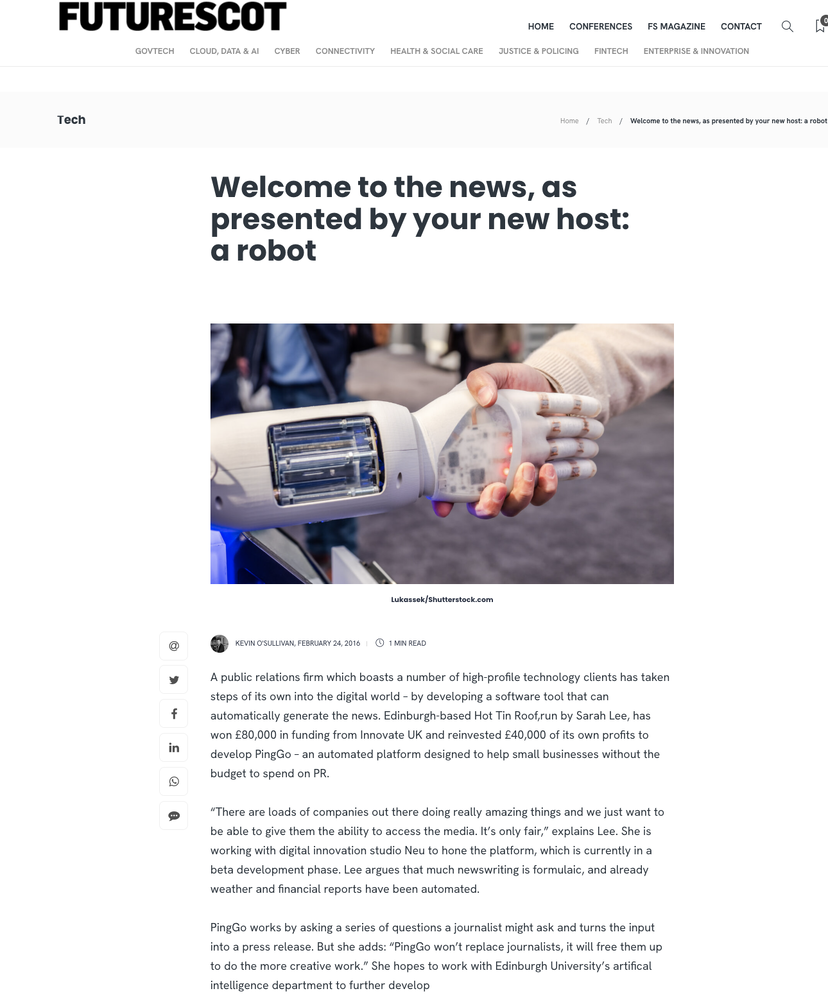
In September 2016, Computing magazine wrote about a UK government-backed start-up that had set out to automate PR, “giving rise to the real possibility that press releases may soon be produced by robots for other robots to read.”
They were writing about PingGo, the platform I built. It never had a line of AI in it, but it wasn’t for want of trying.
Why I built it
After twenty years in PR, one thing really bothered me. Most companies never do PR at all. They think it’s expensive, mysterious and only possible if you know the right people.
I didn’t believe that. Making news is a process. It can be broken down, and it can be learned.
So that’s what PingGo did. A simple question-and-answer wizard asked the questions a journalist would ask. What’s the story? Why now? Who cares? What’s the proof? Answer them honestly and you had a press release a news desk could use.
Innovate UK backed the build. We launched on Product Hunt in February 2017, and by that October more than 2,000 people had signed up. An AppSumo promotion brought in 965 lifetime customers across 67 countries. People everywhere wanted to do their own PR. They just needed someone to show them how.
I wanted AI from day one
Our first business plan set out the ambition in black and white: use artificial intelligence so the product “learns and gets better every time it is used”, and use natural language generation to write the news itself. In our final report to Innovate UK, I told them we planned to bring AI into PingGo next.
The plan was to prove the product first, then raise a larger round to fund the AI. By 2019 our business plan was naming the technologies I was sure would reshape PR: machines that write, machines that measure, and machines that match a story to the journalists most likely to care.
It never happened. The funding for that phase never came, and the natural language tools of the day that could turn a football score or a set of quarterly results into a paragraph couldn’t find the story in a founder’s messy notes.
So PingGo did the next best thing. If a machine couldn’t do the thinking, we would teach people to think like journalists.
The writing wasn’t generated. It was guided.
The intelligence in PingGo was twenty years of instinct about what journalists need, turned into questions. No algorithm wrote a word.
Then the world changed. In late 2022 ChatGPT arrived, and suddenly anyone could produce a competent press release in seconds. The thing I had wanted to build, and the thing I’d spent years trying to make easy, both arrived at once, and for free.
I’ve thought a lot about what that means for me and for my profession.
1. Structure still comes first. AI is only as good as what you ask it. A good prompt for a press release is essentially the set of questions PingGo asked in 2017. We built the scaffolding the machines now need. Knowing what makes a story newsworthy is still the job.
2. The writing was never the hard part. The question I heard most from PingGo users wasn’t “how do I write this?” It was “who do I send it to?” Finding the right journalist, at the right moment, with the right story, is still where PR is won or lost.
3. The journalist is the real customer. In 2017 I wrote in our Innovate UK report that our real customer was the journalist, and that in an age of fake news, journalists needed to trust their sources more than ever. That matters even more now. When content costs nothing, inboxes flood. Relevance, relationships and trust become the scarce things.
What it did for us
We used PingGo at Hot Tin Roof too. In six months the team ran 60 media distributions, secured 1,500 pieces of coverage and saved an average of three and a half hours on every sell-in. Not because the tool was clever, but because it made a good process easy to repeat.
So will AI kill PR?
People ask me this a lot. I think it will kill lazy PR: the scattergun release, the generic pitch, the story nobody asked for. Good riddance.
What it can’t replace is judgement. Knowing which story matters, and which journalist will care about it. Being the kind of source people trust.
I spent years wishing PingGo had AI in it. Looking back, the absence taught me more than the technology would have. We had to work out exactly what good PR thinking looks like, one question at a time. That turns out to be the most valuable thing anyone can bring to AI now.
PingGo was built on the belief that anyone can learn to make news. I still believe that. The tools have changed. The craft hasn’t.
I’d love to hear from others in PR and journalism. What has AI changed in your work, and what hasn’t it touched?